
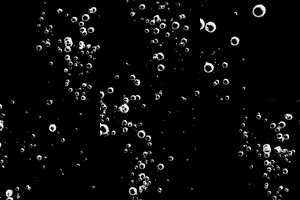
Bong percolators work by forcing smoke through water via multiple small holes or slits, creating bubbles that cool the smoke and filter particles through increased surface area contact. This diffusion process transforms harsh hits into smooth, flavorful draws.
Every time you take a hit from a bong with a percolator, you're witnessing a masterclass in applied physics that would make your high school science teacher proud.
The satisfying bubble symphony isn't just for show, it's the sound of hot, harsh smoke getting transformed through precise engineering that leverages water's natural properties to deliver those impossibly smooth hits that make quality glass worth every penny.
Here are some fundamental facts that describe what a percolator in your bong really does.
- Surface tension and bubble formation ensure maximum water-to-smoke contact
- Proper water levels optimize filtration without restricting airflow
- Multiple percolators provide staged cooling and progressive particle removal
- Quality glass construction prevents thermal stress and ensures consistent performance
In the Thick Ass Glass collection, you can find premium bongs and dab rigs featuring scientifically engineered percolator systems including tree percs, honeycomb designs, and matrix configurations. Our pieces use thick borosilicate glass and precise hole placement to deliver the smooth, consistent filtration that proper physics demands.
Most percolators fail due to poor engineering that ruins their function. Keep reading to discover what separates premium percolated pieces from cheap imitations.

The Physics of Smoke Diffusion
Understanding what does a bong percolator do requires diving into the fascinating physics happening inside your glass piece. When you take a hit, you're witnessing several complex physical processes working together to transform harsh smoke into smooth, cooled vapor.
How Surface Tension Creates Perfect Bubbles
Surface tension acts like an invisible skin on water, and percolators exploit this property brilliantly. As smoke gets forced through tiny holes or slits, the water's surface tension creates uniform bubble formation. These bubbles maximize the contact area between hot smoke and cool water.
The smaller the percolator holes, the more bubbles form. More bubbles mean exponentially more surface area for cooling and filtration. This is why quality percolators feature precisely engineered hole sizes rather than random openings.
Heat Transfer: The Cooling Science
Water absorbs heat from smoke through conduction and convection. The heat transfer coefficient of water is roughly 25 times higher than air, making it incredibly efficient at cooling.
Here's what happens during each bubble's journey:
- Hot smoke enters at around 400-600°F
- Water contact drops temperature by 200-300°F instantly
- Cooled smoke exits at near room temperature
- Throat irritation reduces by up to 70%
Particle Filtration Through Turbulent Mixing
Percolators create turbulent water flow that traps particles through several mechanisms. The chaotic bubble motion forces smoke particles to collide with water molecules repeatedly.
Larger ash particles get trapped immediately, while smaller tar particles require multiple water contacts. This is why multi-chamber percolators outperform single-stage designs for filtration efficiency.
Pressure Dynamics and Airflow Optimization
Percolators create controlled pressure differentials that optimize airflow. The restriction forces smoke through water while maintaining smooth draw resistance.
Properly designed percolators balance back-pressure with airflow volume. Too little restriction means poor filtration. Too much creates difficult draws that defeat the purpose of smooth hits.
The key is finding percolators with engineered hole patterns that create optimal pressure gradients for your preferred draw style.

Water Level Optimization for Maximum Performance
Getting your water levels right is crucial for understanding what does a bong percolator do effectively. Too little water and your percolator won't create proper diffusion. Too much water and you'll reduce airflow, making draws harder and potentially causing water to splash into your mouth.
How Much Water Should You Use for Different Percolator Types?
Each percolator design requires specific water levels for optimal performance:
- Tree Percolators: Fill until water covers the bottom slits of each arm by about 1/4 inch. You should see all arms bubbling evenly when you take a test draw.
- Honeycomb Percolators: Add water until it sits just above the honeycomb disc. The water should cover all holes but not flood the chamber above.
- Showerhead Percolators: Fill until water covers the slits by approximately 1/2 inch. You'll know it's right when you see consistent bubble streams across the entire length.
- Matrix Percolators: Water should cover the bottom row of holes completely. Test by taking a gentle draw to ensure all holes are actively bubbling.

Does Water Temperature Actually Matter?
Cooler water enhances the impact of a bong percolator by providing better smoke cooling and slightly improved filtration. Room temperature water works fine, but water around 60-65°F creates noticeably smoother hits.
Avoid ice-cold water, which can cause thermal shock to quality glass pieces. The temperature difference also affects bubble formation, with slightly cool water creating more stable, longer-lasting bubbles that increase contact time between smoke and water.
Visual Cues for Perfect Performance
Watch for these signs that your water levels are optimized:
- Even bubble distribution across all percolator holes or slits
- Consistent bubble stack height of 1-2 inches above the percolator
- No dry spots where holes aren't producing bubbles
- Smooth, steady airflow without excessive resistance
If bubbles are weak or inconsistent, add more water gradually. If you're getting splashback or the draw feels restricted, pour out some water until you find the sweet spot.
Test your levels with a gentle draw before your session. Properly filled percolators create a satisfying bubbling sound and visible action throughout the chamber.
Why Multiple Percolators Create Exponential Improvement
What does a bong percolator do when you pair it with another? Bubble magic becomes even more fascinating when you see how multiple percs work together. Each additional percolator doesn't just add more filtration, it creates a compounding effect that dramatically transforms your smoking experience.
How Staged Filtration Creates Progressive Cooling
Think of multiple percolators as a cooling assembly line. The first perc breaks down the smoke into smaller bubbles and drops the temperature significantly. The second perc takes those already-cooled bubbles and breaks them down further, creating even more surface area for heat exchange.
Here's what happens at each stage:
- First percolator: Reduces smoke temperature by 15-25 degrees and filters larger particles
- Second percolator: Further drops temperature by 10-15 degrees and catches finer particles
- Third percolator: Provides final polish, removing remaining harshness
This staged approach means the final result is exponentially smoother than what any single perc could achieve.
When Different Perc Types Work Better Together
Combining different percolator styles creates the ultimate filtration system. A tree perc paired with a honeycomb delivers completely different benefits that complement each other perfectly.
Winning combinations include:
- Showerhead + Honeycomb: Maximum diffusion followed by fine filtration
- Tree + Matrix: High bubble count with smooth, even draw
- Turbine + Inline: Cyclonic action plus horizontal diffusion
Each perc type handles different aspects of filtration, so pairing them strategically gives you the best of both worlds.
Finding the Sweet Spot Before Diminishing Returns
More isn't always better with percolators. After three quality percs, you'll start hitting diminishing returns where additional filtration barely improves smoothness but significantly increases draw resistance.
The optimal setup typically includes:
- 2-3 percolators maximum for daily use pieces
- Focus on quality over quantity in perc construction
- Balance between filtration power and comfortable draw
Balancing Filtration with Draw Resistance
Multiple percolators inevitably increase the effort needed to clear your piece. The key is finding percs designed with proper hole sizing and spacing to maintain reasonable airflow while maximizing filtration benefits.
Quality multi-perc pieces use strategic engineering to minimize drag while preserving the smooth hits that make the extra percolators worthwhile.
Best Thick Ass Glass Bongs with Multiple Percolators
24’’ Double Honeycomb Double Interior Showerhead Bong - This tall boy is a prime example of a system designed for maximum percolation and cooling

19’’ Inline to Super Slit Fixed Showerhead Bong - This medium sized has smartly positioned chambers to guarantee perfect airflow couple with excellent filtration.

24’’ Super Slit Pyramid to Interior Showerhead Beaker Bong - Wide base provides additional water volume as well as stability, while the perc combo delivers the finishing touch.

Engineering Flaws That Ruin Percolator Function
Even if you know what a percolator does in a bong, it won’t help you much when poor engineering sabotages the entire system. Even the most sophisticated percolator designs fail spectacularly when manufacturers cut corners on critical construction details.
Poor Hole Sizing Creates Uneven Diffusion
The most common flaw lies in inconsistent hole sizing across the percolator surface. When holes vary dramatically in diameter, some create massive bubbles while others barely allow smoke passage.
This uneven diffusion defeats the primary purpose of a bong percolator. Instead of uniform cooling and filtration, you get hot spots where large bubbles carry unfiltered smoke directly to your lungs.
Quality percolators made by Thick Ass Glass maintain precise hole dimensions, typically between 1-3mm depending on the design. Cheaper alternatives often show visible size variations that create turbulent, ineffective airflow patterns.
Weak Joint Construction That Fails Under Use
Bong joints represent the highest stress points in any glass piece. Poor welding techniques create microscopic fractures that expand with thermal cycling and regular cleaning.
We've seen countless pieces where the percolator separates from the main chamber after just weeks of normal use. These failures typically occur at the base connection where the percolator meets the water chamber.
Premium construction uses proper annealing processes and reinforced joint areas. The glass should show smooth, even connections without visible stress lines or color variations at joint points.
Incorrect Perc Placement Reduces Effectiveness
Percolator positioning directly impacts water levels and smoke flow dynamics. Too high, and you can't maintain proper water coverage. Too low, and you get excessive drag that ruins the smoking experience.
Many manufacturers place percolators without considering optimal water-to-glass ratios. This creates pieces where the percolator either sits above the waterline or requires so much water that clearing becomes impossible.
Proper placement allows 1-2 inches of water coverage above the highest holes while maintaining reasonable water volumes for normal operation.
Why Cheap Glass Can't Handle Thermal Stress
Borosilicate glass quality varies dramatically between manufacturers. Lower-grade glass contains impurities and inconsistent thermal expansion rates that create internal stress points.
When hot smoke contacts these stress points repeatedly, micro-fractures develop around percolator holes. These eventually become full cracks that compromise both function and structural integrity.
Quality borosilicate maintains consistent thermal properties throughout the piece. You can identify superior glass by its clarity, consistent wall thickness, and absence of visible bubbles or inclusions in the material itself.

Experience Premium Percolator Performance
Wrapping your head around how percolators work is just the first step. The real difference comes from investing in quality construction that delivers consistent, smooth filtration session after session.
That's why Thick Ass Glass manufactures only the finest bongs and dab rigs, featuring reinforced joint construction, precision-engineered percolator designs, and premium borosilicate glass that withstands daily use.
Our collection includes tree percs, honeycomb designs, and advanced multi-chamber systems that maximize surface area contact for the smoothest possible experience.
Browse our vast collection of premium glass today and discover the difference that quality glass construction makes for your sessions.