

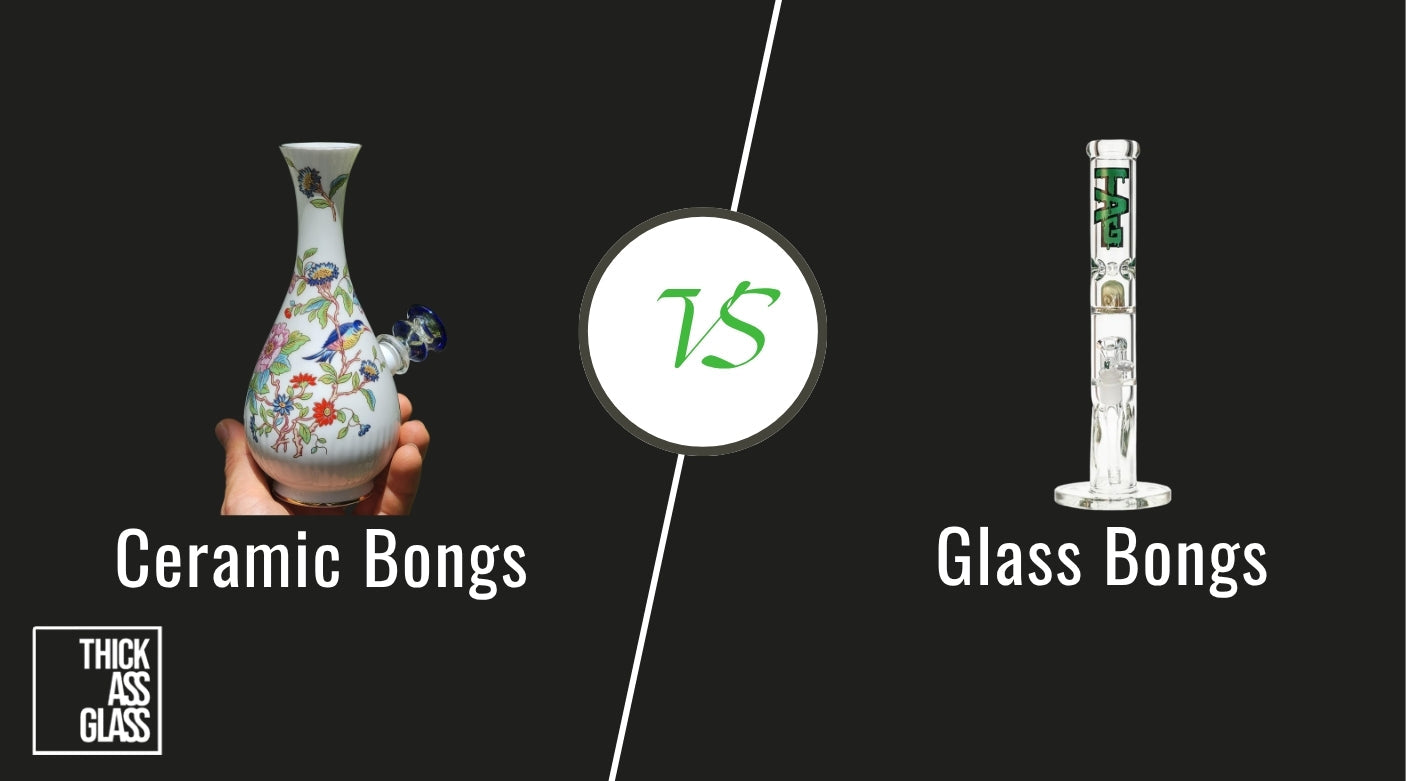
Technically speaking, you can make a bong out of almost anything. How it’s going to hold up in actual practice is another thing entirely. Take glass and ceramic for example. Both are natural materials, both are safe to work with, and both have been used for centuries across all kinds of applications.
That’s where the similarities start to thin out.
Once you actually put them into rotation, the differences show up fast. Not in a dramatic, first-hit kind of way, but in how the piece behaves over time. How it pulls, how it clears, how it feels after a few sessions instead of just one.
Here’s where things start to separate:
- Airflow feel – glass can be shaped with tighter tolerances, which usually translates to a cleaner, more open pull; ceramic tends to feel heavier and a bit more restricted
- Consistency across sessions – glass stays stable; ceramic can shift slightly as it absorbs and holds heat
- Flavor delivery – glass keeps things crisp; ceramic can round things off a bit
- Maintenance – glass cleans back to baseline easily; ceramic holds onto more over time
- Design priority – glass pieces are typically engineered around function; ceramic often leans into form first
That difference in control is exactly why companies like Thick Ass Glass focus so heavily on precision and airflow. When the material allows for it, you can actually tune how a piece performs instead of working around limitations.

If you’ve ever had a piece that just felt right from the first pull to the last, this is where that difference starts to make sense.
Introduction to Ceramic Bongs
Ceramic bongs have been around long before modern scientific glass took over the scene. There’s a reason for that. Clay is easy to shape, holds form well once fired, and allows for designs that would be difficult or impractical in glass. Pick one up and it feels solid, almost dense in a way glass doesn’t quite replicate.
That said, the experience of actually using one tells a more complete story. Ceramic brings a different set of behaviors to the table, and those show up quickly once it’s part of a regular rotation.
Heavier Feel and Slower Airflow
Ceramic pieces tend to run thicker walls and less refined internal shaping. That combination changes how air moves through the piece. Pulls usually feel a bit heavier, with more resistance compared to a well-made glass setup.
Some people like that weight. It gives the hit a slower, more deliberate feel. Others notice it right away as drag that builds over the course of a pull. Since ceramic is molded and fired rather than precision-cut, there’s less control over tight tolerances inside the piece, which is where that difference comes from.
Heat Retention Changes the Session
Ceramic holds onto heat. Not in an extreme way, but enough that you’ll notice it across multiple hits. After a few pulls, the body of the piece warms up and stays there longer than glass would.
That changes how the smoke feels as a session goes on. Early hits feel one way, later hits feel slightly different. The shift isn’t dramatic, but it’s there, especially if you’re paying attention to consistency from start to finish.
Glass, by comparison, resets much faster between pulls. Ceramic carries a bit of that previous heat forward.
Surface and Long-Term Use
Ceramic starts smooth, especially when glazed, but over time it can develop subtle texture inside depending on how it’s cleaned and used. Residue tends to cling a bit more compared to glass, which stays slick and easy to fully clear out.
Cleaning works, but it rarely feels like a complete reset. There’s often a slight carryover that builds gradually with use. For occasional sessions, that’s less noticeable. For daily use, it becomes part of the overall feel of the piece.
That’s really where ceramic lands. Solid, unique, often visually interesting, but with tradeoffs that show up once you start focusing on airflow, consistency, and repeatability.
Key Facts about Glass Bongs
Glass is where things start to feel intentional. The moment you switch to a well-made piece, the pull evens out, the hit clears cleaner, and everything becomes more predictable from one session to the next. That control comes from the material itself and what it allows you to do with design.
Why Borosilicate Glass Works So Well
Borosilicate is engineered to handle heat and stress in a way standard glass can’t, which is why it shows up everywhere from lab equipment to high-end smoking pieces.
- Thermal stability – handles rapid heating and cooling without stress cracking
- Neutral surface – doesn’t interact with smoke, so flavor stays clean and consistent
- Smooth interior – residue has a harder time sticking, which makes cleaning more effective
- Structural clarity – you can actually see what’s happening inside the piece while you use it
- Precision shaping – joints, percs, and internal pathways can be formed with tight tolerances
That last point matters more than anything. Once you can control internal geometry, you can start shaping airflow instead of just hoping it works out.
The Impact of Glass Thickness
Thickness affects more than just how hard it is to break your piece if you drop it.
Thicker glass adds mass, which changes how the piece feels in your hands and how stable it sits during use. A heavier base lowers the center of gravity, which reduces tipping and gives the whole setup a more planted feel.
There’s also a subtle effect on how the piece handles temperature. Thicker sections don’t fluctuate as quickly, so the overall feel of the bong stays more consistent across multiple hits.
Of course, thickness needs to be applied properly. Extra material in the wrong places just adds weight without improving function. When it’s done right, it reinforces stress points and supports the design instead of working against it.

Modular Design and Real Functionality
Modern glass bongs are built around the idea that parts should work together and be replaceable. Downstems, bowls, ash catchers, adapters, all of it connects through standardized joints that keep the system flexible.
That modular approach lets you adjust how a piece performs without replacing the entire setup. You can change diffusion, tweak airflow, or swap components depending on how you want the hit to feel.
It also means you can keep a piece running long-term. If one part wears out or breaks, you replace that part instead of retiring the whole bong.
How to Choose the Right Bong for You
Buying a bong usually starts with looks and ends with function. You pick something that catches your eye, run a few sessions through it, and then reality kicks in. Some pieces stay in rotation. Others slowly disappear to the back of a shelf.
That shift has less to do with style and more to do with how the piece behaves over time. Not one hit. Ten, twenty, fifty sessions in.
Choose Glass as Your Workhorse
Glass earns its place through repetition. You can run the same setup every day and get the same result without adjusting anything. The pull stays consistent, the airflow doesn’t tighten up mid-hit, and the piece clears the way you expect every time.
That consistency comes from precision. Glass joints seal clean, downstems diffuse the same way each time, and the internal path stays unobstructed. There’s no gradual change in how it feels as the piece warms up or as residue builds lightly between cleanings.
It also resets properly. Clean it, and you’re back to square one. It always feels nice and fresh when you put it back into rotation after a deep soak.

Get a Ceramic Bong as a Sidekick
Ceramic fits better as a change of pace than a daily driver. It brings weight, both physically and in how it hits. The pull tends to feel a bit slower, sometimes slightly more restricted, and that gives the session a different rhythm.
It also behaves differently across multiple hits. Ceramic holds onto heat more than glass, so the feel of the piece can shift slightly as you keep going. That’s not inherently bad, but it makes it less predictable if you’re looking for consistency.
Where ceramic shines is in presence. It’s the piece you bring out when you want something with character, something that stands out and feels different in the hand. It adds variety, but it doesn’t replace the piece you rely on when you just want things to work.
Why Thick Ass Glass Bongs Are the Golden Standard
Thick Ass Glass has been doing this since 2013, and it shows in ways you feel immediately once you actually use the piece. A bong that comes from our lab works better, lasts longer, and provides a more satisfying experience than anything you can pick up at a typical bong shop.
Here is what you should know about our business philosophy and our products.
Glassmaking Expertise That Actually Shows Up
TAG works off defined specs, not loose interpretations. Using CAD keeps joint angles, chamber sizes, and downstem lengths consistent across production, so one piece behaves like the next.
Airflow is where that really comes through. Downstems are cut so diffusion spreads evenly instead of channeling through one or two slits. Percs sit where they actually engage with the water level instead of floating in dead space. The draw stays open, smooth, and predictable.
Then there’s the physical side of it. Bases are thick where they need to be, usually in that 12–16mm range, which gives the piece a solid feel and keeps it stable on a table. Joints are reinforced, connections stay tight, and the whole thing feels like it’s meant to be used regularly, not handled carefully.
A Range That Covers How People Actually Smoke
The lineup isn’t cluttered for the sake of variety. Each style lines up with a different way people like to hit.
Beakers give you a grounded, smooth pull with more water volume. Straight tubes keep things quick and direct with less resistance. Larger multi-perc setups bring more diffusion without choking the airflow when they’re done right.
You can move between styles without relearning how to use the piece. The core feel stays consistent, the differences just fine-tune how the hit comes through.
Three TAG Glass Bongs Worth Owning
-
TAG 18" Beaker 50x7MM – 18/14 Downstem
Solid daily piece. Heavy base, steady pull, and enough volume to smooth things out without slowing it down.

-
TAG 12" Straight Tube 44x4MM – 18/14MM Downstem
Clean and direct. Minimal resistance, fast clear, and a straightforward hit that stays consistent.

-
TAG 22" Double 10 Arm Tree Straight Tube 50x7MM – 28/18MM Downstem
Larger setup with stacked tree percs that actually engage. More diffusion, smoother hits, and still maintains an open pull when everything is moving right.

Play Around but Come Back Home to Glass
Ceramic is fun. You bring it out, people notice it, it changes the feel of a session a bit.
Glass is what you keep using.
It’s simply a whole different world that’s hard to leave once you settle into it. The pull feels right, it stays that way, and you don’t have to think about it after that. It just does its job every time you pack it.
That’s really the difference.
If you’re looking for something that ends up being part of your routine instead of something you rotate in and out, you’ll know it when you see it.
Take a look through the Thick Ass Glass lineup of glass bongs and pick something that feels like it’ll stick. We’ve got some really thick pieces and some really cool percolation systems, so you can basically pick every element based on your own vibes.