

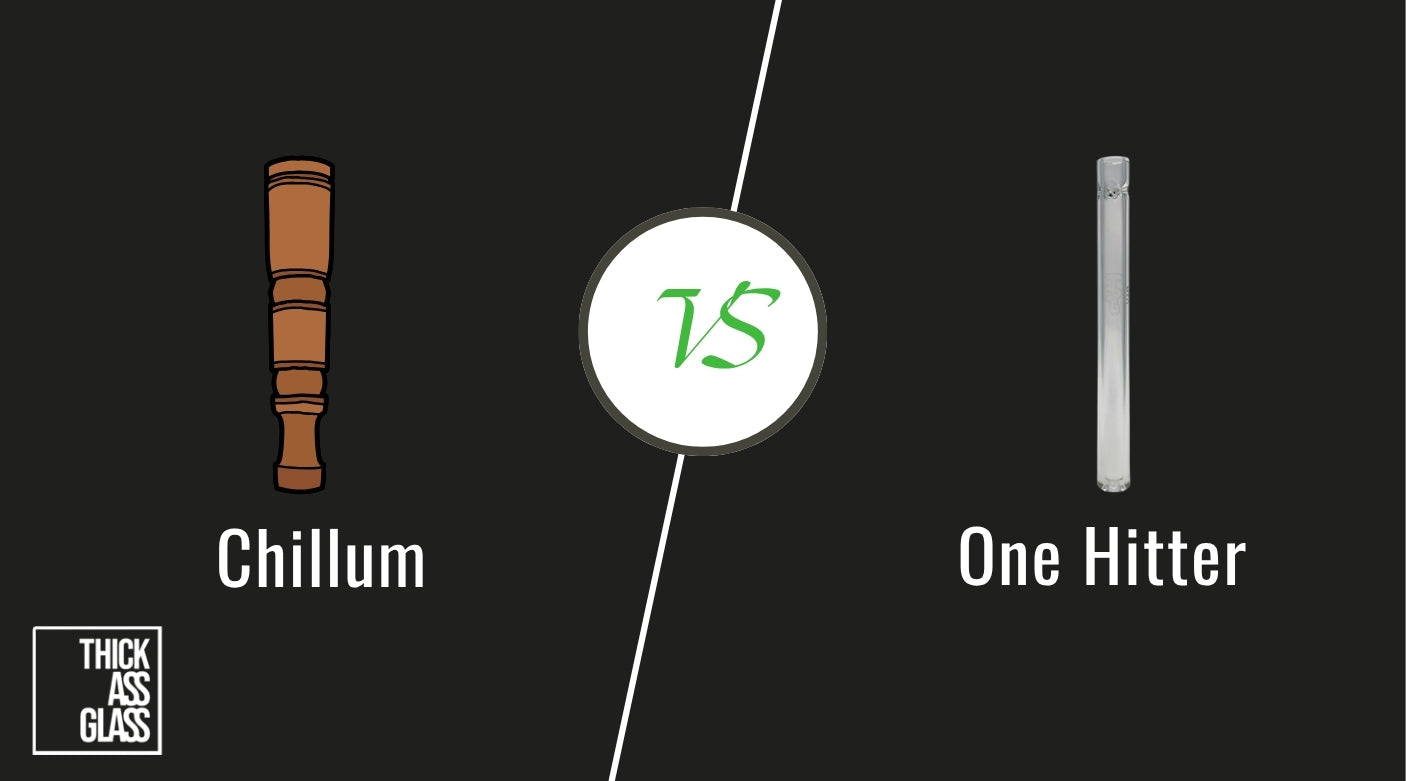
Buy a chillum if you want a simple hand pipe you can pass around for multiple hits, but go for a one hitter if you want quick, single-dose pulls with maximum discretion and minimal waste. Key things to keep in mind are airflow quality, portability, cleaning time, and the overall feel in your hand.
Here’s what matters most when you are choosing between these two pipe style:
- Chillums suit sharing because the bowl is larger and supports multiple hits before reloading.
- One hitters are built for solo dosing, so group sessions turn into constant repacking.
- A built-in screen or pinched screen cuts pull-through, but it also traps residue faster.
- Borosilicate glass holds up better to travel bumps than thin, inconsistent glass.
The team behind Thick Ass Glass obsesses over small-pipe function the same way we do big pieces: CAD-driven consistency, better airflow, and glass that is made to last. Our pipes use quality borosilicate and practical screen designs so you get reliability even in a compact format.

The biggest confusion is that chillums and one hitters can look similar, especially when both are straight tubes. Once you see the design intent behind each one, you will know which style matches your routine.
Are Chillums and One-Hitters the Same Thing?
Chillums and one hitters look similar because both are simple dry pipes you hold in your hand. The confusion comes from the fact that the word “chillum” gets used loosely, even for small single-dose pieces. Once you know what each is built to do, picking the right one gets a lot easier.
Closely Related, Sometimes Combined, Still Distinct
With a chillum, the bowl is typically larger and the overall feel suits a longer session. Then again if you look at a one hitter, you will immediately see that the bowl is tiny by design, so you load less and reload more often.
A lot of people get tripped up because some pieces blend the naming. You might see something called a “one hitter chillum,” which usually means a chillum-shaped pipe with one-hitter capacity. Thick Ass Glass is also guilty of this, as we have a product that merges both functions and effectively acts as both a chillum and a one-hitter.
The Differences between One-Hitters and Chillums
While the designs are related, an experienced eye will quickly recognize which one was used to create a specific pipe. True, every pipe is unique and some may only partially fit the definition of a style, but in most cases it’s not that hard to tell what you are holding in your hand.
Here are the differences we suggest you check before buying:
- Capacity: one hitter = single-dose bowl; chillum = multiple hits before a reload
- Portability and discretion: one hitters are generally smaller and easier to stash; chillums take up more pocket space
- Airflow feel: larger bores tend to breathe easier; tighter bores can feel more restricted if you pack too firmly
- Screen style: built-in or pinched screen reduces the amount of ash that enters the interior tubing of the pipe
In the end, you should shop by features and not by product name.
Chillum Basics You Should Know
If you are weighing chillum vs one hitter, this is the chillum side of the story: where it came from, how to spot one fast, and how to load it without wasting material or scorching your fingers.
Turns out this design has quite a bit of staying power.
Where Chillums Came From
The chillum is one of the oldest pipe formats still in daily use. Its roots trace back to 18th-century India, where Hindu monks and Sadhus used conical clay pipes for spiritual practice and ritual. Early chillums were communally as an offering to the god Shiva, which gave them an important social and ceremonial function.
The format spread outward from India over centuries, turning up across Africa and eventually reaching the West in the 1960s, when travelers brought them home from South and East Asia.
By the time hippie culture picked them up, the core geometry had barely changed: straight tube, wide bowl end, narrow mouthpiece, no moving parts. That is a "clean geometry" that means fewer weird airflow surprises, but it also means your pack technique carries more weight than it does on a more forgiving shape.
So when chillum vs one hitter debates heat up, it helps to remember what the chillum was originally built for: group use, repeatable passes, and a communal experience.
How to Identify a Chillum at a Glance
You can recognize a chillum visually by its straight, tube-like body with a bowl on one end and a mouthpiece on the other. The vibe is “simple cone,” not a spoon shape and not a multi-chamber piece.
Look closely at the bowl end. A true chillum is likely to be much wider on that end, giving you plenty of space to load up your material.
Chillums come in different sizes, but they mostly can fit into one hand. Length is important because it impacts how well the smoke is cooled before it reaches you, but it’s not the only factor to take into account.

Loading and Lighting a Chillum Correctly
Loading and lighting a chillum is all about stable packing and controlled airflow. If you pack too loose, you get hot, fast pulls and ash in the mouthpiece. If you pack too tight, you fight the draw and waste material.
For lighting, keep the flame near the edge and sip the draw like you are tasting soup, not vacuuming a carpet. That approach helps you start an even burn across the top instead of drilling a crater straight down the center.
Here is a short checklist for those who are still getting used to chillums:
- Pack evenly to the rim, then lightly tamp so the surface is level.
- Take a quick “dry pull” to confirm airflow before lighting.
- Light the edge first and rotate the chillum slightly to spread the burn.
- If it tastes harsh fast, your pack is likely too loose or you are pulling too hard.
When you dial in those four steps, a chillum becomes predictable and easy to repeat, which is exactly why the design has stayed popular for so long.

One Hitters at a Glance
If your goal is fast, controlled solo pulls with minimal load size, a one hitter is built for that job. This is the tool people reach for when they want repeatable results, easy pocket carry, and absolute discretion of use.
That “Bat” Shape Is the Point
A one hitter’s design is unmistakable because it is engineered around a tiny bowl and a straight, narrow air path. You are basically holding a slim tube with just enough bowl volume for one measured pull, and that constraint is what makes it useful.
Less internal space means less leftover residue hanging around, but it also means the draw can feel more concentrated if the opening is tight or if the bowl is packed too firmly.
Look closely at the business end: many one hitters use a pinched screen or built-in restriction to keep bits out of your mouthpiece. That little detail changes everything for day to day use, because it affects airflow consistency and how often you need to clean the tip.
Built for Solo Dosing
One hitters are made for solo sessions because reloading is part of the design, not an annoyance. The bowl is intentionally tiny, so you can control how much you use without committing to a bigger pack.
The tradeoff is obvious the moment you try to “pass it around.” You will spend more time repacking than actually enjoying the session, and everyone’s pulls end up uneven because the bowl gets disturbed between turns.
Quick, Discreet, and Low-Fuss
If discretion is your top priority, one hitters win because they are compact, fast to use, and easy to stash in a case. You can take a single pull and put it away without managing a large bowl or a long session.
With a one hitter, you can easily sneak out for a quick solo session even when you are away from home or in a social situation that isn’t smoke-friendly. The residual smoke could still give your secret away so you should be careful where to do it, but compared to any other setup a small pipe leaves the smallest footprint behind.
This is the type of pipe that does its job and goes back into the pocket, with no unnecessary moves whatsoever.
Where to Find a Trusty Pipe for Yourself
By now you know the functional difference in the chillum vs one hitter decision. The last step is buying a piece that actually matches that choice, with decent airflow, sane screen design, and glass that survives real life instead of just looking good in a photo.
Small Pipes Still Need Real Engineering
TAG builds compact pieces with the same rigor we put into larger rigs: CAD-driven geometry, quality borosilicate, and thickness placed where it actually takes the hits. That approach is not overkill for a small pipe. It is what separates a piece that performs consistently from one that feels like a coin flip every session.
Airflow is where you feel our geometry work first. We keep the airway, bowl diameter, and screen placement consistent from piece to piece because even a small variation in bore size changes how the draw feels. If a pipe pulls tight or turbulent, you end up compensating with technique, and that usually means harsher hits and wasted material.
Thickness is the other half of what makes a TAG pipe trustworthy in daily use. We are not adding glass for the sake of it. We are putting material in the spots most likely to catch a countertop edge or a bag drop, so routine handling does not turn into a replacement purchase.
Our Pick for Solo Smokers
To get the best of both worlds and enjoy any kind of session at home or on the move, try the TAG 6 inch One Hitter Chillum with Pinched Screen.

The length gives you a bit more comfort at the mouthpiece, while the pinched screen style keeps loading straightforward and cuts down on fiddling with loose screens.
Dial In Your Perfect Chillum or One Hitter
If you are torn between a chillum vs one hitter, you are already asking the right question: do you want a share-friendly hand pipe you can pass around, or a tight little single-dose dry pipe that keeps things quick and low-waste?
Think of it like choosing between a sturdy shop flashlight and a tiny pocket penlight. Both work, but the job decides the tool.
That is exactly how we build at Thick Ass Glass. We use CAD to keep the details consistent, then focus on the stuff you actually feel in use like airflow and how the bowl and screen setup behaves session after session.
Visit our website today and pick a premium glass pipe you will use daily for years.