

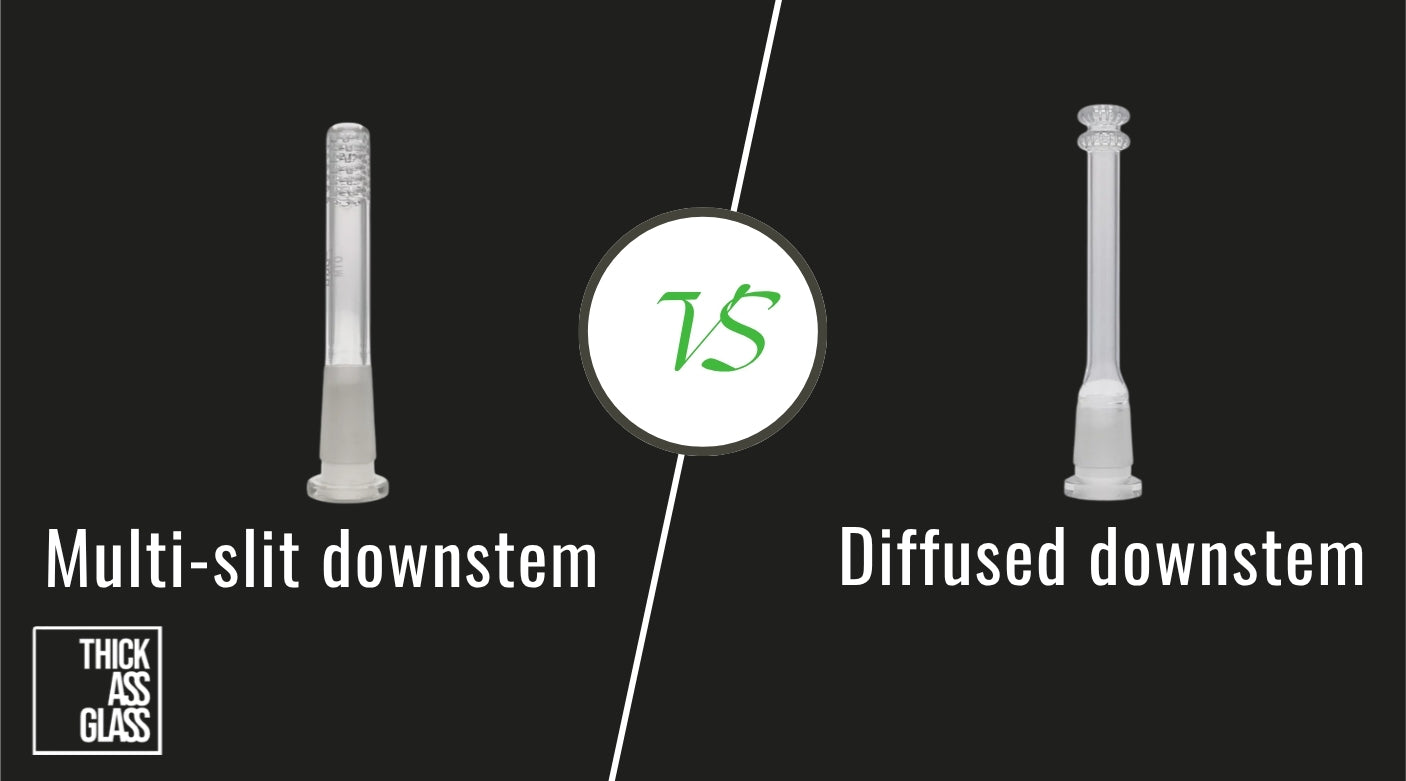
Multi-slit downstems favor an easier draw and stronger flavor. Diffused downstems deliver finer bubbles and cooler hits with more resistance. The difference comes down to tip geometry, how each style handles water turbulence, and what that means for your actual pull.
Most buyers get this wrong at the point of purchase because they are comparing names instead of mechanics. Slit count, open-end versus closed-end construction, and where the tip sits in the water column all change how a downstem performs in your specific setup.
To help you deal with all this terminology, we will discuss the following things:
- How multi-slit designs split flow into multiple small streams, and why open-end construction tends to stay airflow-friendly
- What diffuser geometry changes inside the water, the common diffuser styles, and why “more diffusion” often means more drag
- How to match the stem to your preferences and your setup
- Where to find downstems of both types that work as expected and cause no issues
Thick Ass Glass downstems are engineered to spec, with every stem built around precision taper fit and repeatable measurements. If you are sizing up a replacement or stepping up to a higher-performance option, that engineering is what makes the difference between a stem that works and one that just fits.

Let's get down to the technical level and explain properly why each style has a place in your collection:
How Multi-Slit Downstems Work In a Bong
A multi-slit downstem is basically controlled chaos: you take one smoke column, split it into many smaller outlets, and force that output through water with minimal wasted resistance. The result is a draw that stays lively while still giving you real water contact where it counts.
Slits Turn One Column Into Many Bubbles
The core mechanic is simple: multiple horizontal slits at the stem tip divide airflow into separate jets, which form smaller bubbles than a single open-end outlet. More bubbles means more total surface area touching water during the same pull.
That extra surface area is where multi-slit designs earn their reputation. You get more water contact without having to rely on tiny, easily-stalled holes, so the hit can feel smoother while still keeping the response snappy.
Slit count matters because it controls how “distributed” the output is. A higher slit count (for example, 32-slit designs) spreads the same volume across more exits, which typically produces a denser bubble field and a more even chug across the waterline.
A Straight Shot Into the Water
A multi-slit downstem is still a direct injection system: air enters through the female inner joint, travels down the tube body, and exits through the slits right at the stem tip under the waterline. There is no detour inside the downstem, so the response feels immediate.
Practically, that means your water level and your insert length do most of the tuning. Submerge the slits and you get full bubble formation; ride too high and you lose diffusion. Sit too deep and you can turn the water into a heavy, turbulent drag point that masks what the slit geometry is trying to do.
In our experience, the cleanest performance comes when the stem tip sits roughly 0.25 to 0.5 inches above the base, so the slits can work without the glass bottom interfering with flow patterns.
Airflow-Friendly Fit Across Common Joints
Multi-slit downstems tend to feel airflow-friendly because they keep the pathway open while multiplying outlets at the end. You are not forcing the entire pull through one restrictive feature; you are spreading it across slits that vent in parallel.
Fit is also why the style is so widely used. Most setups come down to two variables: the male outer joint size that seals into your piece, and the female inner joint size that accepts your bowl or slide. Common configurations include 18/14MM and 18/18MM, plus larger 28/18MM for bigger joints..
What Diffused Downstems Do In a Bong
A diffused downstem focuses on one job: breaking a single smoke stream into many smaller bubbles at the stem tip. That change in bubble size and distribution is what drives the smoother, cooler feel people associate with diffusion, along with the trade-off of added resistance.
Why Diffusers Create More and Finer Bubbles
Diffused downstems produce more intense bubble formation because the diffuser geometry splits flow into multiple exit points at the stem tip. Instead of one larger outlet, the smoke is forced through a pattern of cuts or holes that creates many smaller bubbles at once.
Mechanically, this does two useful things in the water: it increases total bubble surface area and spreads the bubble plume across a wider footprint. More surface area means more contact with water per pull, and a wider footprint reduces the tendency for one loud, choppy column of bubbles to dominate the chamber.
The geometry matters as much as the hole count. A tight, evenly spaced pattern tends to generate a consistent “foam” of bubbles, while uneven spacing or oversized openings can behave more like a partially open-end stem, with larger bubbles and less stable diffusion.

Common Diffuser Styles You Will See
Most diffused downstems differ by how the tip is cut and whether the stem is open-end or closed-end. The cut pattern determines how the smoke is partitioned, and the open versus closed construction changes how water moves around the diffuser during a pull.
These are the most common diffuser types experienced buyers run into:
- Matrix downstem: a cylindrical grid of horizontal and vertical cuts that splits flow into a dense, even bubble field simultaneously.
- UFO downstem: a closed-end disc-shaped head with angled slits that forces smoke outward radially for wide, even bubble spread.
- Gridded downstem: a flat or curved grid pattern etched into the tip that divides flow into uniform micro-streams with consistent diffusion.
- Showerhead downstem: a flared, closed-end tip with vertical slits around the rim that fans smoke outward like a showerhead spray.
- Tree downstem: multiple arms branching from a central tube, each with slits at the base, distributing smoke across several exit points.
The Drag Trade-Off
Diffusion usually adds drag, and that can complicate pulls, especially if the diffuser is very fine or the water level is high. The same design that multiplies bubbles also increases flow resistance, because the smoke has to pass through narrower, more numerous pathways.
In practical terms, drag comes from a few predictable sources: restriction at the diffuser openings, turbulence created as jets collide in the water, and extra backpressure when the tip is set deep. The biggest mistake is stacking high diffusion on high diffusion, for example pairing a very tight diffuser with a setup that already has heavy internal percolation.
Which Downstem Style Is Right for You
The right downstem choice is less about what is “better” and more about what you want your pull to feel like, and what your glass can realistically support. Focus on your preferred airflow and smoothness first, then sanity-check fit and structure so the upgrade actually performs.
Match the Downstem to Your Smoking Style
Pick a multi-slit downstem when you want an easier draw and sharper flavor definition without sacrificing diffusion. Pick a diffused downstem when you want maximum smoothing and cooling and you do not mind paying for it with more drag.
In practical terms, multi-slit designs tend to feel more responsive: less resistance at the start of the pull, quicker clearing, and fewer places for buildup to hide. Diffused styles (showerhead, gridded, matrix) push more of the work into bubble-making, so the pull often feels denser and slower, but the output is typically softer on the throat.
Here is a quick reminder to guide your decision:
- Choose multi-slit if you value: fast clearing, lighter drag, and a more “open” pull
- Choose diffused if you value: maximum filtration and cooling, even if the pull tightens
- If cleaning time matters, simpler slit geometry usually stays more manageable over time than complex diffusion cuts

Match the Downstem to Bong Size and Structure
Your glass determines how far you can push diffusion. Smaller setups often feel best with an open-end, multi-slit approach, while larger pieces and higher water volume can take advantage of heavier diffusion without feeling like you are pulling through a clogged filter.
Structure matters, too. If your setup already has percolators doing diffusion work, stacking a very aggressive diffused downstem on top can add drag faster than it adds comfort. In that case, a multi-slit downstem often keeps the overall system balanced.
If your piece is more straightforward internally, a diffused downstem can be the main smoothing stage without feeling redundant.

Why Thick Ass Glass Downstems Are In High Demand
Downstems tend to look interchangeable until you have lived through loose joints, inconsistent diffusion cuts, or glass that feels thin where it matters. Demand concentrates around brands that build for repeatable fit and predictable function, not just a quick replacement.
TAG’s Reputation Comes From Consistency
Thick Ass Glass has over 10 years producing glass and a track record that backs it up.
When most of the industry moved toward thinner, cheaper production to cut costs, TAG held the line: no corner-cutting on wall thickness, no shortcuts on joint construction, no compromises on diffuser tolerances. That decision is why the brand still has a loyal following that keeps growing as more people discover our gear.
The accessories side of the catalog reflects the same standards typical for TAG bongs. We produce high slit-density diffusers, (Super Slit in our brand parlance), which are more difficult and time-consuming to make than standard slit counts. Tolerances on diffusers are held to spec even when it makes production harder, because a diffuser that is slightly off kills the consistency of the bubble field and changes the draw.
Two TAG Picks Worth Shortlisting
TAG 28/18MM 6 Row x 4 72 Hole Multiplying Super Slit Downstem: a high-slit-count, multiplying-rod style build aimed at dense dispersion through many small outlets, suited to users chasing maximum breakup

TAG 28/18MM Closed End Super Slit Single UFO Downstem: a single-UFO diffuser profile with super-slit style cuts, a cleaner, simpler geometry that prioritizes a steady pull while still delivering strong diffusion

Get Downstem Design to Work for You
If you are torn between multi-slit vs diffused downstems, the fastest way to get it right is to match function to your draw and then lock in fitment.
That is exactly where Thick Ass Glass can help. Our downstems are built for predictable performance and precise compatibility, ideal when you want maximum diffusion and cooling and you are not willing to accept too much drag.
Take a look at our collection of premium downstems and decide for yourself which model would be the best match for your bong.