

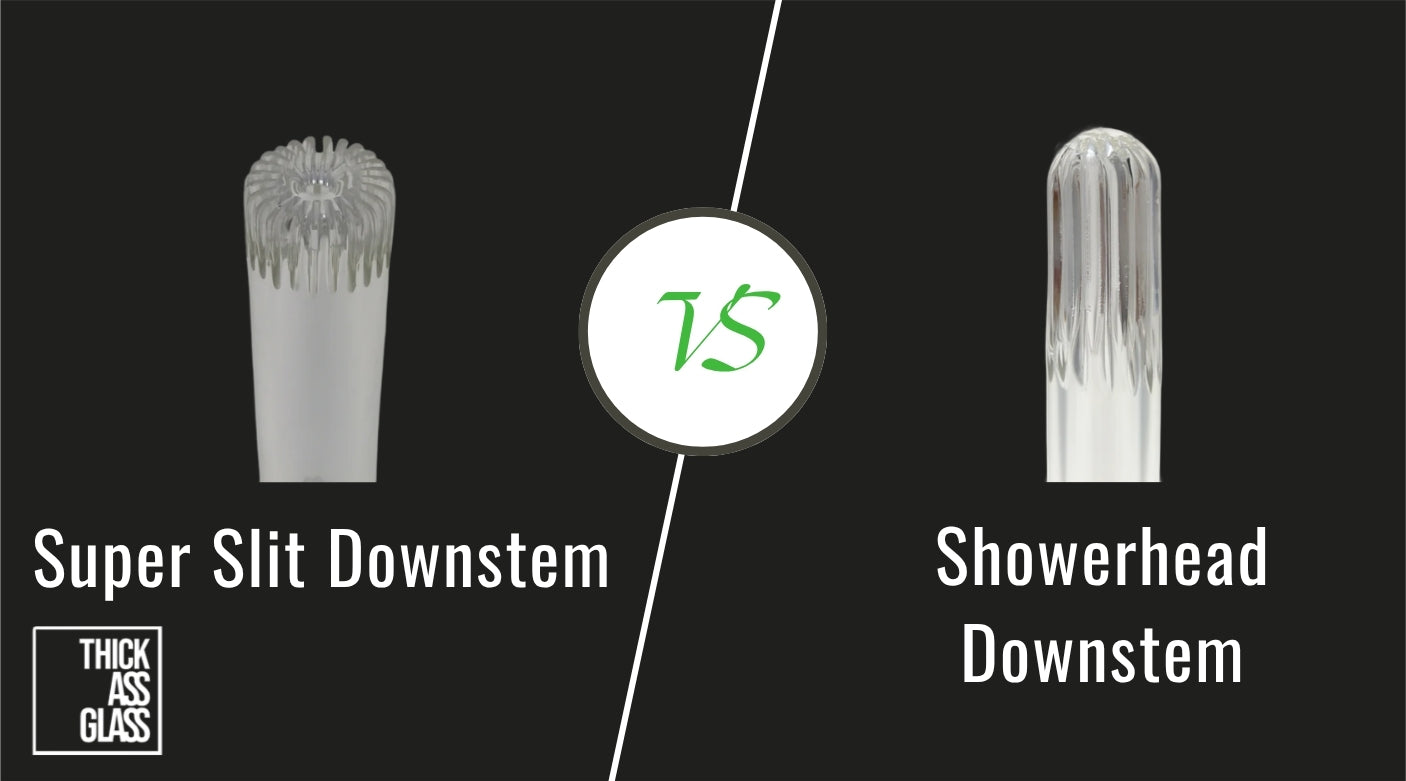
Deciding whether Super Slit or Showerhead design is better depends on what you want your pull to feel like: Super Slit downstems usually deliver higher diffusion and filtration with more airflow resistance, while Showerhead downstems aim for a smoother draw that stays easy and consistent.
If you are tired of buying another downstem that either feels restricted or clogs fast, this breakdown gives you a clear way to choose based on real use.
- How diffusion actually starts inside the downstem before anything hits the water, and why bubble size changes pull quality.
- How to visually spot a Super Slit downstem versus a Showerhead downstem, plus what each design tends to do for drag, flavor, and buildup.
- The practical fit checks that prevent wasted money: joint compatibility (male and female sizing) and downstem insert length so it seals and sits right.
Thick Ass Glass views downstems like engineered parts, not afterthoughts. We use CAD modeling to keep cuts and joints consistent, and we have spent over a decade designing and testing diffuser downstems so you can match a Super Slit downstem or Showerhead downstem to the exact pull you want.

Before you pick your perfect diffused downstem, you need one solid mental model of what diffusion is doing at the downstem itself.
Why Diffused Downstems Are the Gold Standard
A diffused downstem is the simplest way to change how your piece feels without making a dramatic and costly makeover. The cut pattern at the bottom of the downstem controls how smoke enters the water, how bubbles form, and how much effort your draw requires.
Diffusion Starts at the Downstem Tip
Diffusion is happening before anything reaches the main water chamber because the downstem is the first place air and smoke get forced through a restriction. A non-diffused tip pushes one larger stream into the water, while a diffuser downstem splits that stream into multiple smaller jets at the slit pattern or showerhead opening.
That split matters mechanically: smaller jets create more total bubble surface area once they enter the water, which increases contact time and cooling for the same pull. It also spreads the energy of your inhale across multiple entry points, so the water gets activated more evenly instead of getting punched in one spot.
This is why two pieces with the same water level can feel radically different with a downstem swap. The downstem is the first stage that sets the entire filtration behavior in motion.
Bubble Patterns Change the Draw
Bubble pattern goes a long way towards determining the feedback you feel in your lungs. Fine, uniform bubbles usually translate to steadier resistance and a smoother pull, while big, uneven bubbles tend to feel choppy and can surge as the water sloshes.
Cut geometry drives those patterns. A Super Slit downstem uses multiple narrow slits that tend to generate lots of small bubbles and higher water movement, which many readers interpret as “more filtration,” with the tradeoff of more airflow resistance. A Showerhead downstem uses rounded openings that distribute flow more gently, often staying smoother and easier to pull, with less aggressive agitation.
Two quick tells that your bubble pattern is hurting performance are a draw that pulses (you feel it ramp up and down mid-pull) and bubbles that stack into one side of the chamber instead of spreading across the base.

A Low-Cost Performance Upgrade
A diffuser downstem is one of the least expensive ways to upgrade performance because it targets the bottleneck. If your current downstem has minimal diffusion, the rest of the piece is forced to work with larger bubbles and less water contact, no matter how well everything else is made.
It is also a practical swap: you can keep the same joint size and insert length and simply change the diffusion style to tune draw resistance and smoothness. In day to day use, that can mean fewer harsh spikes in the pull and a more predictable inhale that feels “dialed in,” especially on standard beaker setups.
Explaining the Super Slit Downstem Design
A Super Slit downstem is essentially a diffuser downstem that uses many narrow, precision-cut slits to break your pull into a dense field of small bubbles. The design is easy to spot once you know what to look for, and it tends to push filtration harder than simpler cut patterns.
What a Super Slit Downstem Looks Like
A Super Slit downstem looks like a standard glass downstem until you get to the business end: the lower section is patterned with multiple thin slits cut into the tube.
Those slits are usually arranged in rows or a gridded layout around the bottom tip, so smoke and air exit through many small openings instead of one large outlet. Depending on the exact model, you may see a closed-end tip (the bottom is sealed, forcing air out through the slits) or an open-end version (the tube remains open, with slits adding extra diffusion).
Visually, the tell is uniformity. The cuts look evenly spaced and consistent in length, which matters because inconsistent slit geometry can create uneven bubbling and weird draw behavior. Here are some of the main characteristics of this style:
- Tube body with a dense slit pattern near the bottom
- Multiple rows or a grid of slits rather than a single ring of cuts
- Either closed-end (sealed tip) or open-end (open tube) construction
Why the Super Slit Cut Pattern Works
The advantage of the Super Slit pattern is straightforward: more openings create more, smaller bubbles, which increases water contact and can noticeably smooth out the pull.
In our experience designing and testing diffuser downstems, the Super Slit style is a good match for smokers who want maximum filtration and do not mind some added airflow resistance. That resistance is not a flaw, it is the predictable tradeoff of forcing the same volume of air through many narrow exits.
Another practical upside is consistency. A well-executed slit layout tends to produce stable bubbling across a range of pull strengths, instead of going from “inactive” to “chugging” depending on how hard you draw.
Here are some of the main advantages of this style:
- Higher diffusion density: lots of small bubbles instead of a few large ones
- More water agitation for cooling and particulate drop-out
- More controlled, repeatable bubbling behavior when the slit geometry is uniform
- Tradeoff: increased airflow resistance compared to simpler, larger openings
Best Super Slit Downstems from TAG
TAG 28/18MM 6 Row x 4 72 Hole Multiplying Super Slit Downstem. This style is aimed at aggressive diffusion in a larger diameter configuration, which translates into powerful hits that feel feathery.

TAG 18/14MM 10 Rows x 2 (60 holes) Open End Rounded Super Slit Downstem With a symmetrical distribution of slits, this stem targets a balanced feel: strong bubble production without choking the airflow.

Showerhead Downstem Design In a Nutshell
A showerhead downstem is built to give you smooth, consistent diffusion without turning the draw into a workout. The design is easy to spot once you know what you are looking for, and its performance traits are predictable.
What a Showerhead Downstem Actually Looks Like
A showerhead design entails a rounded, “cap-like” end with multiple openings arranged around it, so smoke exits in several directions rather than through one big outlet.
Visually, the diffuser end looks like a small dome or rounded tip with a ring of holes or slots. Instead of long slits running up the tube (as in slit-based designs), the working area is concentrated at the bottom, where the openings spread the flow outward into the water.
That layout is the entire point: it distributes the flow evenly so bubble formation stays stable and the water movement stays controlled, even with a steady pull.
What It Does for Your Bong’s Pull and Smoothness
A showerhead downstem can make your bong feel smoother and more “open” on the draw while still improving diffusion compared to a plain, non-diffused stem.
Because the openings are rounded and spread out, the airflow typically feels less restrictive than very fine, high-count slit patterns. In practice, that translates to an easier pull and a steadier bubbling sound, with less of the “chug” that comes from aggressively agitating the water.
Expectations matter: showerhead diffusion is designed to be consistent and comfortable, not necessarily the most aggressive filtration possible. Here is what you can expect from it.
- Smoother feel through more even bubble distribution at the diffuser end
- Lower perceived airflow resistance than many dense slit patterns
- Controlled water movement that tends to stay consistent across different pull strengths
- A straightforward upgrade path for pieces that feel harsh with basic, non-diffused stems
Best Showerhead Downstems from TAG
TAG 14/10MM Closed End Rounded Showerhead Downstem: A compact, closed-end showerhead option designed for smaller joint sizes, with rounded showerhead openings aimed at smooth filtration without excessive resistance.

TAG Open End 4 Slit Showerhead Downstem 18/14MM: An open-end stem that adds four slits to the showerhead-style diffusion, great when you want a slightly more active bubble break-up while keeping the draw manageable.

Why it Makes Sense to Have Both Designs in Your Collection
Super Slit and Showerhead downstems solve different problems, so owning both is less about collecting and more about control. One day you may want maximum diffusion and filtration, and the next you may want a smoother, easier draw without changing anything else about your piece.
Switch Your Diffusion Style on Demand
Swapping between a Super Slit downstem and a Showerhead downstem is the fastest way to change how your setup feels without changing the water pipe itself. The downstem is the part that sets bubble size, water agitation, and how much resistance you feel on the pull.
In practical terms, a Super Slit downstem is the move when you want more aggressive diffusion and filtration, and you do not mind a bit more airflow resistance. A Showerhead downstem fits the sessions where you want a smoother draw that stays consistent and easy.
The common mistake is treating the choice as permanent. If your joint size and insert length are consistent, the swap is a genuine “two downstems, two personalities” upgrade.
Run Both Designs in One Downstem
A hybrid downstem lets you stack the effects: Super Slit style cuts create lots of fine bubbles, while a Showerhead-style opening distributes that output more evenly at the bottom. The result is usually a balanced pull that does not lean as hard into either extreme.
This combo approach also simplifies decision-making. Instead of asking, “Do I want diffusion or smoothness today?”, the hybrid aims to keep the diffusion strong while keeping the draw predictable.
From an engineering perspective, it is a single piece doing two jobs: breaking the airflow into many paths, then spreading those paths in a rounded, showerhead-like pattern as they enter the water.
TAG’s Best One-Piece Combo Pick
Jane West x TAG 18/14mm Closed End Rounded Super Slit Showerhead Downstem is the straightforward choice. We built it to deliver Super Slit diffusion with a Showerhead-style outlet in one closed end downstem.

Dial In Your Bong’s Pull With the Right Downstem
If your pull feels harsh or inconsistent, the fastest fix is usually at the downstem. More diffusion generally means more filtration and cooling, but it can also add airflow resistance. That is why many readers land on Super Slit as the daily-driver upgrade, then keep a Showerhead option on hand for a smoother, easier draw.
Thick Ass Glass is known for precision-fit borosilicate downstems with tight, ground joints and repeatable cut patterns. We’ve got every model imaginable from both families, so you can find a downstem that does more than just connect the bowl with the bong.