

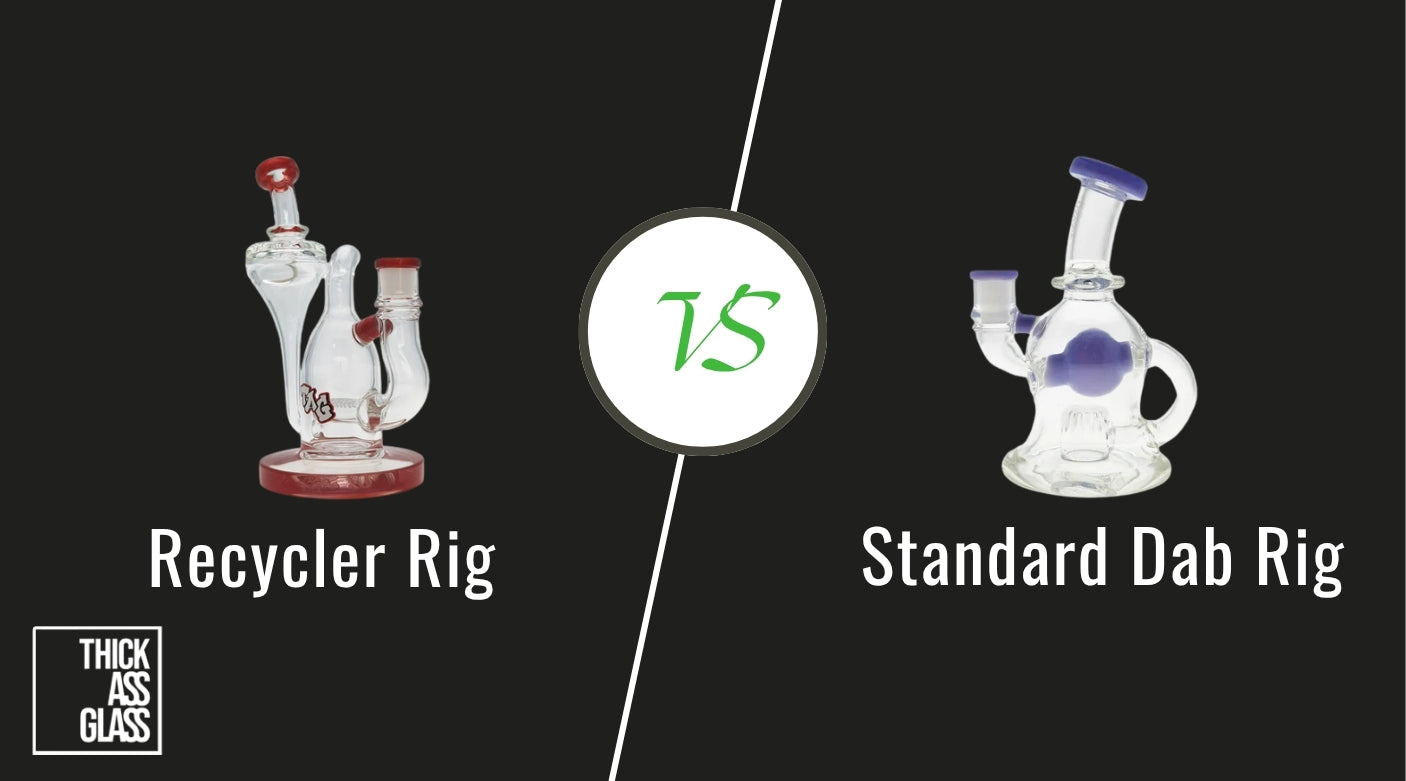
Yes, upgrading to a recycler dab rig is worth it if you care most about smoother, flavor-forward low-temp pulls and you are willing to keep the water level dialed and the tubes clean.
Most people asking this question already know the standard rig works. What they want to know is whether the recycler actually feels different enough to justify the gap. The answer lives in the mechanics, not the marketing, so here is exactly what this article covers:
- How a recycler actually works inside: uptake tube, dual chambers, drain tube, and what happens during a full water cycle from the first pull to the last.
- What that circulation does for your hit: why vapor stays cooler, how low-temp flavor survives the water path, and why splashback is a non-issue when the geometry is right.
- How airflow balance decides everything: the role of vacuum pressure, tube angles, and chamber volumes in making a recycler feel effortless instead of sluggish.
- Where to find a great recycler: explaining the difference between precisely engineered TAG recyclers and the rest of the field.
People at Thick Ass Glass come at recyclers like glass nerds with calipers, not hype merchants. We carefully plan our water and air paths and build with thick borosilicate glass to ensure stable pressure zones and precise tube geometry. That’s why every dab rig in our collection looks like a work of art and performs like clockwork.

Let’s break down how recycler rigs function so you know exactly what you are paying for.
How Recycler Rigs Function
A recycler dab rig is basically a little glass pump and filter that runs on your inhale. The whole trick is two chambers and a pair of tubes that keep water circulating while vapor moves toward your mouthpiece, so each pull stays cool, clean, and consistent.
What a Recycler Actually Looks Like
You can spot a recycler by its “loop” layout: two chambers connected by visible tubing, plus a mouthpiece on top and a joint for your banger/nail on the side. It looks busier than a simple rig because the plumbing is the feature, not decoration.
In most builds, the primary chamber is the base where water starts and where diffusion happens (often through a percolator). Above or beside it sits the secondary chamber, which acts like a separation zone that helps keep water moving without dumping it straight into your mouthpiece.
Here are the parts of a recycler you will easily recognize once you see them:
- Dual chambers: create two pressure zones that make circulation possible during a draw
- Uptake tube: carries water up from the primary chamber toward the secondary chamber
- Drain tube: returns water back down by gravity to restart the loop
- Percolator: breaks incoming vapor into smaller bubbles for more water contact
How Vapor Travels Through a Recycler
Vapor enters the rig from the banger/nail, gets pulled into the water in the primary chamber, and then rides airflow up to the mouthpiece. The recycler layout keeps that path in close contact with moving water instead of a single, static pool.
Here is the simple mental picture we use: your inhale is the engine, the uptake and drain tubes are the belt drive, and the chambers are the reservoirs. As vapor is drawn through the percolator, the same pull that moves vapor forward also encourages water to lift and return, so vapor keeps meeting relatively fresh, cooler water during the hit.
That balance depends on an airtight seal at the joint and the right water level. Vacuum pressure is what makes a recycler feel “alive” in your hands, and any air leak turns the whole system lazy.
What Happens During a Full Cycle
A cycle is the repeating loop of water moving up, over, and back down while you inhale. You are not just pulling vapor, you are actively driving the water path the entire time.
During the draw, inhalation creates vacuum pressure in the primary chamber. That pressure difference pulls water up through the uptake tube into the secondary chamber, where airflow helps keep the lift steady instead of dumping.
Then gravity takes over. Water feeds back down through the drain tube into the primary chamber, ready to be lifted again, and this repeats for as long as your inhale stays consistent.
Here is what the cycle looks like:
- Pull starts: vacuum pressure builds in the primary chamber
- Water lifts: uptake tube carries water to the secondary chamber
- Water returns: drain tube brings water back down by gravity
- Loop repeats: circulation continues until you stop inhaling
Recycler Performance vs a Traditional Dab Rig
A recycler dab rig earns its reputation on feel, not hype. The circulation design gives you more cooling control, keeps flavor intact when you stay low-temp, and it’s built to keep water where it belongs during a pull.
Superior Cooling From More Water Contact
A recycler cools better because your vapor spends more time interacting with water that is actively moving, not just sitting in one spot. In practical terms, you get a smoother pull at the same heat and you can take a longer draw without the “hot edge” showing up halfway through.
The trick is the water cycle created by vacuum pressure in the dual chambers: as you inhale, water is pulled up the uptake tube, sent into the second chamber, and returned through the drain tube. That constant circulation keeps presenting fresh water surface area to the vapor stream, so heat gets pulled out more consistently than a simple single-chamber setup.

Flavor Retention at Low Temps
Recyclers tend to shine at low temps because the vapor stays comfortable while you keep the heat conservative, so you can actually taste what you paid for. You are not forced to crank temperature just to make the hit tolerable.
Cooling is only half the story. Because the water is cycling, you avoid a situation where a warm, already-saturated pocket of water and air dominates the water path. Fresh circulation helps keep the session tasting “clean” hit after hit, especially when your airflow balance and water level are dialed so the cycle stays steady.
No Possibility of Splashback
A properly engineered recycler design is meant to prevent splashback because the uptake tube, drain tube, and chamber volumes manage where the water can go under suction. You pull vapor through the water path while the cycling action keeps the water working inside the chambers instead of launching it up the mouthpiece.
The practical expectation is simple: you can pull with confidence, even on a stronger inhale, because the water movement is constrained by the pressure zones and tube angles. When those angles are right, the rig cycles instead of flooding.
When Upgrading to a Recycler Is a Good Idea
A recycler upgrade makes the most sense when you already know your way around a banger and you can actually feel the difference between “fine” and “dialed.” These are the three types of users we see get the most real-world value from the swap.
Experienced Dabbers Who Want Smoother Pulls
A recycler dab rig is a smart upgrade when you already have your technique consistent and you are chasing comfort: less bite on the inhale, less throat irritation, and a hit that stays stable from start to finish.
At that point, the recycler’s constant water circulation is doing work you can feel. As you draw, the water keeps cycling through the dual chambers, so the vapor keeps meeting fresh, cool water instead of warming up the same pool. In our shop experience, that’s why seasoned users describe recyclers as “easier to take a full pull on,” especially during longer sessions.
This is also the group that benefits from small tuning moves. A recycler responds clearly to water level and to tiny airflow changes, so your carb cap technique and joint seal matter more than they did on a simpler setup.
Here are some of the signs you might be ready to switch:
- You already run low-temp dabs and want the same vapor density with a softer feel on your lungs
- You take longer draws and want the hit to stay smooth instead of turning sharp mid-pull
- You enjoy dialing water level so the uptake tube cycles cleanly without splashback
Flavor Chasers With Good Concentrates
A recycler becomes “worth it” fast when your concentrates are already high quality and you care about taste more than brute-force cloud size.
Flavor gets wrecked by heat and sloppy airflow. With a recycler, the circulating water helps keep temperatures more controlled during the draw, and a well-balanced water path reduces the chance of water creeping where it should not. You end up tasting more of what you paid for because the rig is not fighting your technique.
Glass Collectors Who Want Something Different
A recycler is a great upgrade when you collect for function and form, and you want a piece that feels engineered rather than generic.
Recyclers put the design right out in the open: dual chambers, uptake and drain tubes, and tube angles that have to be correct for the water cycle to stay smooth. That makes them fun to own because you can actually see the physics at work during a pull, not just admire a silhouette on the shelf.
Why TAG Has the Best Recyclers In the Market
A recycler only earns its worth when the water cycle is reliable, the airflow is clean, and the glass survives real life. That’s the lens we use when we build and spec our recycler lineup: function-first engineering with durability you can actually feel in-hand.
An Established Brand That Engineers the Water Path
TAG has been making recyclers for over a decade, and that time adds up in ways that matter.
Recyclers are unforgiving. A tube angle that is slightly off, a chamber volume that is too large or too small, a joint that does not hold vacuum pressure cleanly: any of those things and the cycle feels wrong. You notice it immediately as a user. We noticed it immediately as makers, and we kept refining until we stopped noticing it at all.
That history shows up in the details you feel during a session: stable, consistent cycling, ergonomics that do not fight you, and joint fits that hold pressure the way they are supposed to. Ten-plus years of iteration is a hard thing to fake.
Elegance That Holds Up
Recycler can look like art, but it still has to be a daily driver. That tension is where TAG expertise actually shows up: every design decision gets made with both in mind, not one at the expense of the other.
On the glass side, we build with thick borosilicate throughout. Dab rigs take heat stress every single session, and thin glass telegraphs that abuse fast.
On the function side, the percolator is where most recycler designs quietly fail. We run Super Slit Puck percs in our Klein Incycler builds specifically because slit geometry breaks vapor into finer bubbles without choking airflow.
More water contact, less drag. That is the balance that makes a recycler feel effortless rather than like you are fighting the piece on every pull.
We also build bellow bases into several of our rigs because stability matters on a piece you are setting down on a hard surface next to a hot banger.
Pick the Best TAG Recycler Today:
8’’ Klein Super Slit Puck Klein Incycler Dab Rig: Great when you want an easy-to-handle recycler that still delivers smooth, cool pulls without taking over your desk.

TAG 10" Klein Incycler w/ Super Slit Puck Dab Rig: More height and presence for longer, more relaxed sessions where you want a bit more room for cooling.

Once You Feel Recyclers, There Is No Going Back
Recyclers feel like overkill to most people. They are expensive, complicated, fragile, tough to clean. Yet despite all these concerns, they remain in high demand.
Thick Ass Glass makes good use of its glassmaking proficiency to craft recycler rigs that perform just like you would expect them to and last a long time with reasonable maintenance.
Getting a TAG rig is the best way to get all the advantages of recycler design without being exposed to the downsides. We invite you to check if this is true by ordering your first recycler from our website.