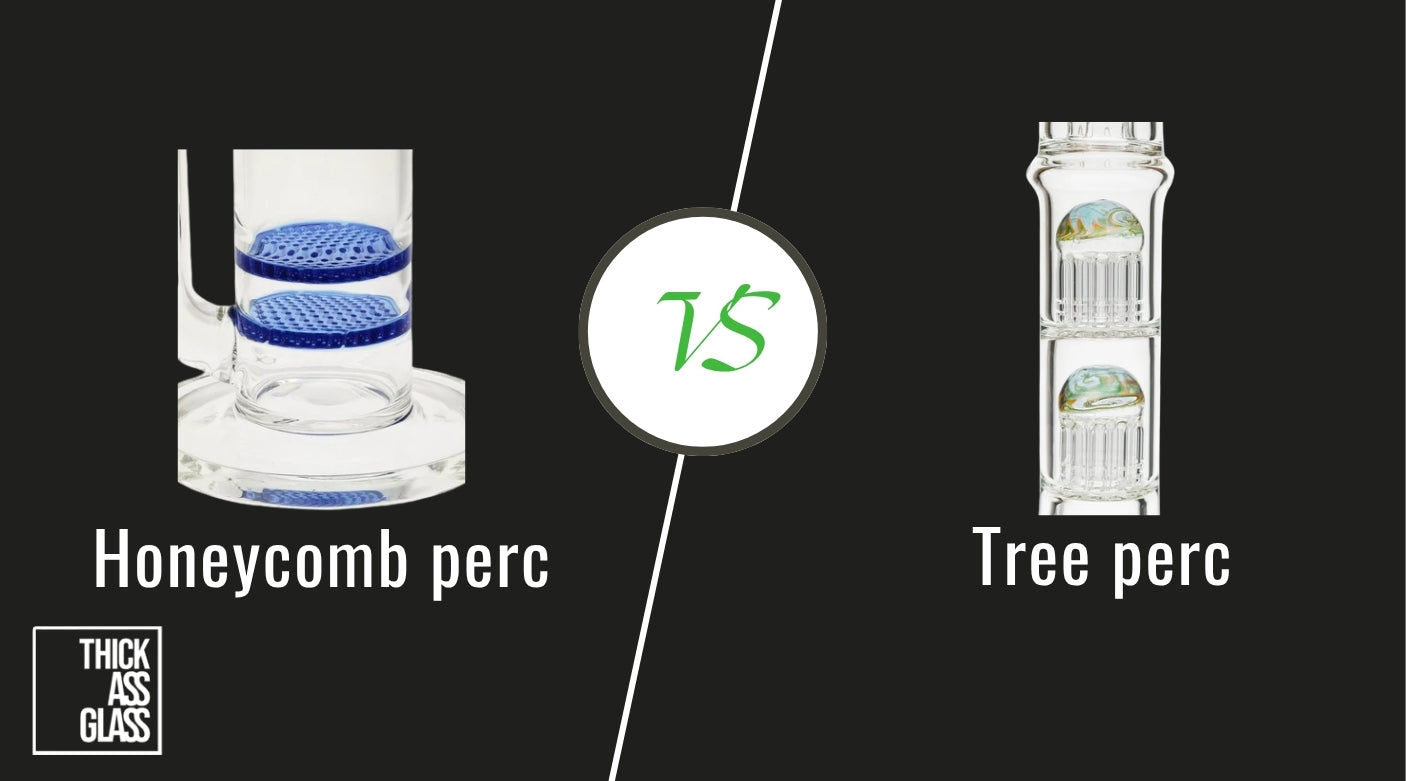
Honeycomb percs usually fit you best when you want smooth, even diffusion with relatively low drag. Tree percs usually fit you best when you want maximum diffusion and a more active, bubbly pull, and you are willing to stay on top of cleaning.
A perc that doesn't fit your smoking habits quickly becomes a chore. A honeycomb disc and a tree arm assembly are solving the same problem (breaking smoke into bubbles) but they get there through completely different geometry.
Here are the main distinctions between them.
- Diffusion style: Honeycomb discs push smoke through dozens of laser-cut holes in a single flat plane for even, uniform diffusion. Tree percs split airflow across multiple arms, each acting as its own bubble nozzle, producing a livelier, more active bubble stack.
- Drag: Honeycomb percs tend to offer a steadier, more open draw. Tree percs increase resistance with arm count, and stacked trees can feel noticeably heavier to pull.
- Smoothness and cooling: Both cool smoke effectively, but high-arm-count tree percs and double honeycomb stacks push diffusion furthest, delivering the softest hits.
- Flavor: Fewer percolation stages generally preserve more flavor. A single honeycomb disc tends to retain more taste than a triple-stacked tree running maximum diffusion.
- Cleaning difficulty: Honeycomb discs are easier to soak and rinse because there are no protruding parts. Tree arms create tight corners and crevices where residue collects and pipe cleaners struggle to reach.
- Durability: Flat honeycomb discs have no fragile protruding arms to snap. Tree arm assemblies carry more structural risk, especially in multi-arm configurations.
When designing Thick Ass Glass pieces, we approach percolator bongs like an engineering problem. To solve it, we dig deeper and try to project the exact paths that smoke will travel along inside a bong. That is why our lineup includes everything from single-perc builds to stacked tree and honeycomb combinations.

To understand exactly whether a honeycomb or a tree perc is right for you, stay with us through the end of this comparison guide.
Honeycomb Perc Design Explained
Honeycomb percs earn their reputation through simplicity. There are no moving parts, no arms to knock loose, and no complex geometry to work around. Everything about the design is built around one idea: force smoke through as many small, evenly spaced holes as possible so diffusion happens consistently across the whole disc, not just in one concentrated spot.
What a Honeycomb Perc Actually Looks Like
A honeycomb percolator is a flat, disc-shaped perc that sits inside the tube, with a tight grid of small, laser-cut holes across its face. Instead of arms or multiple branches, you are looking at one clean plane that forces smoke to split into lots of tiny paths at once.
In most pieces, the honeycomb disc is fused to a central stem or tube that routes smoke into the underside of the disc. The disc is positioned horizontally, usually in its own chamber, so water can fully submerge the hole pattern without flooding the neck.
Here is how you can instantly recognize this percolator type:
- Disc geometry: a round, flat honeycomb disc sealed to the glass body
- Hole pattern: uniform laser-cut holes spaced evenly for consistent diffusion
- Placement: typically set level in the chamber so the entire grid can sit under water
- Variants you may see: single disc, double-stacked discs, or an interior honeycomb layout within a larger chamber

What Happens When Smoke Passes Through It
When smoke hits a honeycomb disc, it is forced through dozens of small holes, turning one stream into many micro-streams. Underwater, those micro-streams exit as a dense field of small bubbles, which increases the contact between smoke and water.
That contact is the whole point: more surface area and more turbulence in the chamber, without relying on fragile protruding parts. The result tends to be even diffusion across the entire disc, assuming your waterline covers the holes. If the disc sits above the water, you lose most of the percolation effect and the pull feels more direct.
How a Honeycomb Bong Hit Feels
A honeycomb bong usually feels smooth and controlled, with relatively low “chug” and a steadier pull compared to more animated designs. You typically notice a finer bubble texture and a more uniform draw, rather than big surges of bubbling in one spot.
What you feel depends heavily on the hole count and whether the piece stacks multiple honeycomb discs. More holes and more stages can add resistance, but it is often a consistent, predictable resistance instead of a turbulent, splashy one.
Tree Percolator Design At a Glance
Tree percs take a completely different approach to the same problem. Instead of one flat plane doing all the work, a tree perc distributes airflow across multiple arms, each acting as its own diffusion point. That architecture gives you a livelier, more active hit, but it also means more variables to manage, from arm count to water level to long-term maintenance.
How to Spot a Tree Perc
A tree percolator is the one that looks like a tiny branching chandelier inside your tube: a central stem with multiple arms extending outward, each ending in slits or small openings.
You will usually see it sitting in its own chamber below the neck, and the giveaway is that the smoke path splits into many outlets at once. Trees are commonly offered in a wide range, roughly 6 to 34 arms, and you will also see stacked configurations (double or triple trees) where multiple tree percs are placed in series.
Here are some signs that you have a tree percolator in front of you:
- Central stem plus multiple arms (branches) that terminate in slits/openings
- Fixed arm tree vs spinning tree (rotating action during the pull)
- Arm count called out as a spec (often 6, 10, up to 34)
- Single vs stacked trees (double or triple perc chambers)
Airflow Physics: What the Arms Actually Do
When smoke enters the central stem of a tree perc, it is forced to split and travel outward into each arm simultaneously. Because every arm acts as an independent bubble source, diffusion is distributed across the full width of the assembly rather than concentrated in one point. That distribution is what gives tree percs their characteristically dense, active bubble stack.
The geometry of each arm directly controls bubble size and draw resistance.
Longer arms give smoke more distance to travel before exiting, which encourages finer, more consistent bubble formation. Slit width at the arm tip is the other critical variable: narrower slits shear smoke into smaller bubbles, while wider slits lower resistance and move higher volume with less effort. Arm count compounds both effects.

Real-World Performance: What a Tree Perc Hit Feels Like
A tree perc hit is unmistakable. The moment you pull, you feel the resistance spread across multiple arms at once, and the smoke that reaches you is noticeably cooler, softer, and more filtered than what a basic downstem delivers. It does not feel sharp or harsh. It feels like the smoke has been worked over before it gets to you.
The bubble action is part of the experience too. A dense, churning stack fills the chamber, and you feel that activity in the draw itself, a fuller, more layered pull rather than a thin stream. High arm counts push this further, rounding off any remaining edge on the smoke and adding a weightiness to the inhale that heavy hitters tend to prefer.
The hit lands smooth, cool, and satisfying. That is what a tree perc is built to deliver, and at higher arm counts, it is hard to beat.
Who Should Get Honeycomb vs Tree Perc Bong
Honeycomb vs tree percs is less about “better” and more about where you want your complexity: inside the glass (diffusion) or in your routine (cleaning and setup). Use the scenarios below to match the perc style to your day-to-day use, then sanity-check your pick against the comparison table.
Best Uses for a Honeycomb Perc
A honeycomb perc fits best when you want consistently smooth diffusion with a pull that stays relatively open. The disc-style design spreads smoke through many laser-cut holes at once, so the hit tends to feel even instead of “bursty.”
This style makes sense for regular home sessions where you value predictability: you fill to fully submerge the honeycomb disc, take a test pull, and the piece tends to behave the same way each time. Honeycombs also pair well as a first-stage or second-stage perc in stacked builds because the diffusion is uniform across the full disc.
Here are the typical situations where getting a honeycomb makes sense:
- You prioritize a balanced mix of filtration and airflow, not maximum turbulence
- You prefer a more even, “sheet-like” diffusion instead of large, choppy bubbles
- You want a perc that behaves consistently across different water levels
- You are willing to rinse and soak on schedule so the laser-cut holes stay clear
Best Uses for a Tree Perc
A tree perc fits best when you want maximum diffusion and a more active, bubbly pull. By splitting smoke through multiple arms, a tree percolator creates many parallel streams, which is why well-built trees can feel exceptionally cooled and refined.
Tree percs are also the obvious choice when you like to tune diffusion by design. Trees also stack readily in double and triple configurations for people who want that layered “churn” in a straight tube.
The cost is complexity. More arms and more junctions mean more places for residue to settle, and a tree typically rewards longer soaks and a bit more hands-on cleaning.
Here is the list of scenarios where a tree percolator might be optimal:
- You want the most diffusion possible, even if it introduces more draw resistance
- You enjoy visible percolation and a lively chamber during the pull
- You like choosing an arm count and sometimes stacking percs for extra filtration
- You do not mind longer cleaning sessions to reach between arms and around the central stem
To make your decision easier, let’s compare the styles directly:

Why TAG Percolator Bongs Are Best in Class
Thick Ass Glass has spent over 10 years engineering percolator bongs built to last. Every piece starts with borosilicate glass at thicknesses most brands never attempt, paired with percolator designs chosen for real performance, not aesthetics.
Whether you are shopping for a honeycomb disc, a tree arm assembly, or a stacked combination of both, we got just what you need.
Precision Engineering as the Baseline
With our pieces, consistency is treated as a design requirement, not a lucky outcome.
The practical difference shows up in how predictably a perc “lights up” across the whole structure. Honeycomb percs rely on uniform, laser-cut hole patterns, and tree percs rely on evenly built arms that sit at the right height and spacing to bubble without uneven drag.
Durability is part of that same philosophy. Thick borosilicate walls and notably thick bases are used so the piece feels stable in daily handling and stays aligned over time, which matters when you are asking internal parts like discs and arms to perform the same way session after session.
Single-Perc to Multi-Perc Options That Make Sense
TAG offers single-perc designs for cleaner airflow and simpler maintenance, plus multi-perc stacks when you want a longer, more conditioned pull.
In practice, single honeycomb setups tend to feel open while still smoothing the draw, and single tree setups deliver more visible bubbling with a slightly more active pull. Multi-perc builds add stages: a honeycomb-to-honeycomb stack increases uniform diffusion, and honeycomb-to-tree hybrids combine even diffusion up front with higher diffusion downstream.
Three TAG Picks: Honeycomb, Tree, and a Hybrid
- TAG 13’’ 6 Arm Tree Straight Tube: A straightforward tree perc build with a modest arm count, so the arms break the stream into multiple bubbles without turning the draw into work.

- TAG 12’’ Bent Neck Double Honeycomb with Spinning Splashguard: Two honeycomb discs stage the diffusion so the pull feels noticeably smoother and more uniform, while the bent neck and spinning splash guard are there to prevent splashback.

- 21’’ Double Honeycomb to Fixed 34 Arm Tree: A true hybrid stack where the smoke is conditioned through two honeycomb stages before it hits a high-arm tree.

Nobody Else Can Pick the Right Perc for Your Bong
The behavior of each percolator style may be driven by physics, but the final decision between them is bound to be subjective. After all, it’s your bong and you get to decide exactly what type of percolation you want it to produce.
By shopping at Thick Ass Glass website, you can keep your options open. We have a wide range of bongs on offer, including models that have built-in tree arms and/or honeycombs.
That means you never have to settle for the wrong design just because of availability.