

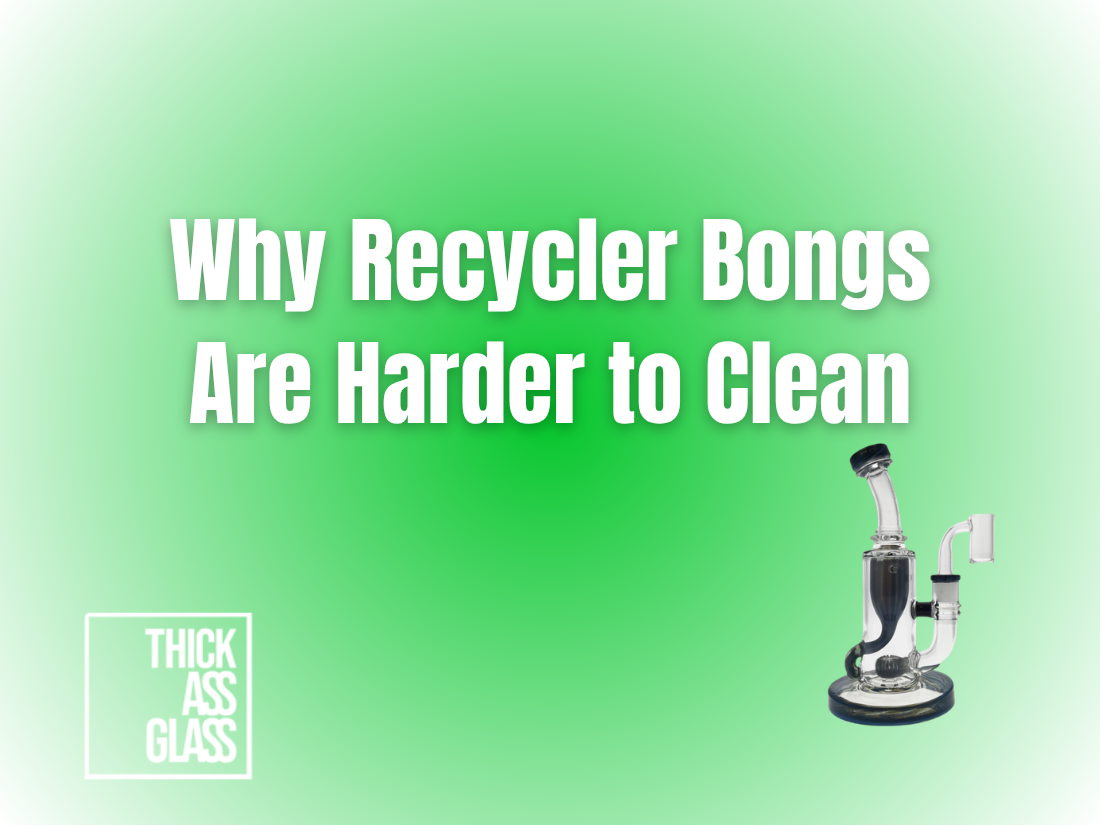
Recycler bongs are harder to clean because their internal tubes, chambers, and recycling pathways create more places for resin to collect. Knowing where buildup forms and how to clean those areas properly helps preserve airflow, flavor, and smooth water cycling. This guide explains why recyclers require different cleaning techniques and how to keep yours performing like new.
Here’s what you need to know at-a-glance:
- Recycler bongs have more internal pathways, making them more difficult to clean than traditional water pipes.
- The drain tube, uptake tube, and secondary chamber are the three most common areas for resin buildup.
- Quick rinses often miss hidden residue, leaving behind buildup that affects flavor and airflow.
- Clean recycler tubes from both ends and rinse along the natural flow path for the best results.
- Avoid twisting or forcing brushes through tight bends to protect the glass.
- Routine cleaning with the right tools helps maintain smooth water cycling and extends the life of your recycler.
TAG offers a range of cleaning accessories that make it easier to maintain recycler bongs, from flexible brushes and pipe cleaners to cleaning solutions that help remove buildup from hard-to-reach areas. With the right tools and a regular cleaning routine, it's easier to keep your recycler cycling smoothly and tasting fresh.
Keep reading to learn where recyclers collect residue, why standard cleaning methods often fall short, and the techniques that keep your recycler tasting fresh and cycling smoothly.
The Real Problem: Resin Pressure Zones
Recycler bongs move water differently during a hit than they do during a rinse.
When you inhale, pressure pulls water through the recycler system. Water rises through the uptake tube, enters the secondary chamber, and returns through the drain tube. That movement is strong and directional.
When you rinse it in the sink, the flow is weaker and less controlled.
Water takes the easiest path. Resin does not.
That is why buildup stays in the tubes.
Dual Chambers Create More Places for Resin to Settle
A recycler has at least two water areas: the main chamber and the secondary chamber.
Those chambers are connected by tubes, and every connection creates corners, ledges, and transition points. When water is actively cycling, those spots may look fine. But once the pull stops, liquid slows down and residue settles.
Common dead spots include:
- Main chamber corners below the waterline
- The top and bottom of the secondary chamber
- Junctions where the uptake tube meets the chamber
- Junctions where the drain tube returns water
- Small ledges inside the recycler pathway
These areas do not flush as easily as open glass.
That is not user error. That is recycler geometry.
Uptake and Drain Tube Angles Slow the Rinse
The uptake tube and drain tube are the hardest areas to clean because they are narrow and angled.
During a hit, suction helps water move through those bends. During cleaning, you usually do not have the same pressure. So rinse water flows through the easiest openings and leaves a thin sticky film on the inside walls.
That film builds up over time.
At first, it is just a faint amber line. Then it becomes a cloudy stripe. Then it turns into a dark ring or ridge that affects airflow and water cycling.
If your recycler still smells dirty after a rinse, the problem is probably not the main chamber. It is the tube path.
Why Quick Rinses Miss the Sticky Line
A quick rinse usually cleans the big visible surfaces first.
That feels productive, but the worst residue is often hidden inside the narrow tube sections. Water sheets down the open chamber walls while bypassing the tight angles that actually need attention.
Quick rinses miss buildup because:
- Water chooses the widest path
- Air pockets interrupt the rinse
- Tube bends reduce flow speed
- Resin sticks hardest at junctions
- Narrow sections do not get enough direct pressure
This is why a recycler can look clean from five feet away and still hit like an old basement.
The glass is not clean until the tubes are clean.
The Three Main Gunk Traps in Recycler Bongs

Most recycler cleaning problems come from three areas.
If your piece tastes stale, cycles weakly, or keeps getting cloudy after cleaning, check these first.
1. The Drain Tube Choke Point
The drain tube is where water returns from the secondary chamber back to the main chamber.
It is also one of the most common places for buildup.
The choke point usually forms near a bend or where the tube meets the chamber. Water slows down there, resin catches, and the buildup starts narrowing the return path.
You may see:
- A dark amber ring
- A brown ridge inside the tube
- A glossy varnish-looking line
- Water returning slower than normal
- Cycling that starts but does not finish cleanly
This matters because the drain tube is what completes the loop.
If the drain path is restricted, the recycler cannot recycle properly. It may still bubble, but bubbling is not the same as clean cycling.
2. The Uptake Tube Tide Mark
The uptake tube tide mark is the recycler version of a bathtub ring.
It forms where water repeatedly climbs and drops during your pull. That same height gets coated over and over, creating a layered line inside the tube.
At first, it may look light amber or cloudy. Over time, it becomes more stubborn because it is not just loose grime. It is multiple dried layers stacked on top of each other.
Look for it:
- Inside the uptake tube
- Around the usual waterline height
- Along the outside of a bend
- Near the path where water first lifts
This tide mark can affect flavor before it affects function. That is why a recycler may still cycle but taste off.
3. The Second Chamber Sludge Shelf
The secondary chamber can collect residue on small interior ledges or low-flow areas.
This buildup often looks like a dull smear or muddy patch instead of a clean ring. It forms when heavier particles settle out of the moving water and dry between sessions.
This spot is easy to miss because the chamber may still look mostly clear.
Signs of secondary chamber buildup:
- Cloudy brown film
- A patch on one side of the chamber
- Water turns cloudy quickly after refilling
- Stale smell returns after cleaning
- The chamber looks clean until light hits it
This is where a bottle brush or direct soak matters. Rinsing alone usually does not remove the compacted film.
How to Clean Recycler Tubes Without Stressing the Glass

The goal is not to attack the piece.
The goal is to clean the actual flow path.
Recycler bongs have arms, joints, bends, and welded sections. You need to clean them without twisting, levering, or forcing tools through tight areas.
Empty Both Chambers First
Always drain the main chamber and secondary chamber before adding cleaner.
If you leave trapped water inside, it dilutes your cleaning solution and pushes loosened resin deeper into the tubes.
Drain slowly and deliberately.
Do this:
- Remove the bowl or downstem if removable
- Pour out the main chamber first
- Rotate the recycler to empty the secondary chamber
- Tilt until hidden water leaves the recycler arm
- Check for pooling in low points before adding cleaner
Do not aggressively shake the piece just to get water out. Support the base and neck, rotate slowly, and let gravity do its job.
Brush Tubes From Both Ends
Most recycler buildup forms around bends and pressure zones.
That means brushing from one side only may not reach the problem.
Use small pipe cleaners or flexible brushes that match the tube diameter. Work from both entries whenever possible.
For the uptake tube:
- Brush from the main chamber side
- Then brush from the secondary chamber side
For the drain tube:
- Brush from the secondary chamber side
- Then brush from the main chamber return side
Use short strokes. Pull back often. Rinse the cleaner. Re-wet the area.
Never jam a brush through resistance. If it catches, back out and use a thinner cleaner or longer soak.
Rinse Along the Flow Path
Rinse the recycler the way water moves during use.
That means sending water through the main chamber, into the uptake tube, through the secondary chamber, and back down the drain path.
Then reverse the direction.
This helps flush loosened residue instead of moving it from one tube into another.
Good rinse routine:
- Rinse from the main chamber toward the uptake tube
- Rinse through the secondary chamber
- Rinse back through the drain tube
- Reverse the flow through the other opening
- Repeat until water runs clear
- Smell the mouthpiece and joint for cleaner residue
If rinse water keeps turning cloudy, there is still buildup hiding in the tubes.
Breakage-Proof Handling While You Clean
Recycler bongs are most vulnerable during cleaning.
Not because the glass is weak, because your hands are applying pressure in weird places.
The piece is wet. The cleaner is slippery. The tubes are narrow. The joints can take torque if you hold the wrong section.
Handle it like a tool, not a trophy.
Hold the Base, Not the Neck
Grip the base and the widest part of the main chamber.
Do not use the mouthpiece, neck, joint, or recycler arm as a handle while scrubbing.
Best grip points:
- Base
- Main chamber body
- Thickest glass sections
Avoid using these as handles:
- Mouthpiece
- Neck
- Joint collar
- Exposed recycler tubes
- Thin chamber connections
Most cleaning damage happens when someone twists the piece from the top while pushing a brush through a lower tube.
That torque has to go somewhere. Usually, it finds a joint.
Never Lever Against a Bend
A pipe cleaner is not a crowbar.
If the brush stops at a curve, do not pry, push harder, or bend the glass against the tool. Tube bends concentrate force, and a small hairline crack may not show up until later.
Use sliding contact, not leverage.
Better method:
- Push gently
- Stop when resistance appears
- Back out
- Add more cleaner
- Approach from the other side
- Try again with less pressure
If you have to force it, you are using the wrong method.
When Soaking Beats Force
If resin acts like a plug, soak longer.
Do not muscle it.
Soaking is safer when:
- A pipe cleaner buckles
- The brush hits the same hard stop
- You need two hands to push
- The tool bends against the tube wall
- Buildup is dark, thick, or hardened
Use warm cleaning solution and time. Let the residue soften, then brush lightly.
Borosilicate glass is strong, but sudden uneven force around a narrow bend is still a bad idea.
Make Recycler Cleaning Easier

Keeping a recycler clean comes down to staying ahead of buildup. Pay attention to the uptake tube, drain tube, and secondary chamber, and clean them before residue has a chance to restrict airflow or slow the water loop.
The right tools make the job faster, safer, and more effective. Shop TAG's collection of cleaning supplies to keep your recycler cycling smoothly and performing like new.